
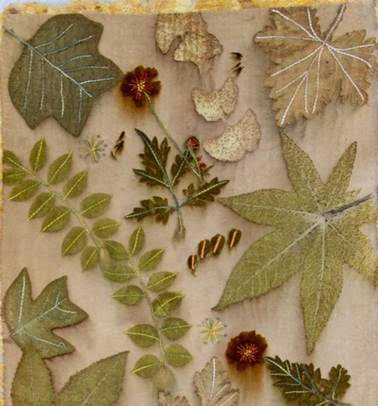
Botanical Printing on Silk with Karen Selk
This is a 2 1/2 day workshop, May 29-30-31, 2026
Friday May 29 2 pm – 4ish Foraging botanicals Held at the 5616 Yarrow Road
7 pm – ? Keynote Presentation Held at the Quail’s Nest Art Center on Airport Road in Oliver
Saturday May 30 9 am – 4pm Workshop Day 1 Held at the Quail’s Nest Art Center on Airport Road in Oliver
Sunday May 31 9 am – 4ish Workshop Day 2 Held at the Quail’s Nest Art Center on Airport Road in Oliver
Class cost: 300.00, Includes 3 days plus the Keynote presentation.
Keynote presentation only 20.00 RSVP lynn@ujvary.ca
Once we have a full class you will get an email giving further instructions on payment, securing your spot.
Please check out Karen’s Book In Search of Wild Silk: Exploring a Village Industry in the Jungles of India : Selk, Karen: Amazon.ca: Books, Karen is THE authority on wild silk in India. She’ll have copies with her for purchase.
Class Description
BOTANICAL PRINTING
Cotton and different Silks will be treated (mordanted) with minerals to encourage a large selection of leaves to impart their unique print. The addition of tannins, iron and natural dyes will give different effects and colours to the background cloth. Samples made during the workshop will include a variety of techniques to help achieve satisfying prints.
Bio
Karen Selk is a textile artist, writer, educator and entrepreneur with a lifelong passion for silk. For over 35 years, she has studied wild silk traditions in India, culminated in her book: In Search of Wild Silk: Exploring a Village Industry in the Jungles of India. Over the course of her career, she has shared her expertise worldwide through workshops, lectures, videos and numerous articles in textile magazines. Her work has been featured in international exhibitions and is represented at Gallery 8 on Salt Spring Island. Karen lives on Salt Spring Island where the natural beauty inspires her art, writing and organic gardening.
Class Overview
Day 1
- Introduction to botanical printing
- Working only on samples to understand techniques and the variables involved in the outcome of the prints
- Discuss characteristics of leaves to take advantage of their strengths: colours, tannins or resists
- Different fabrics print differently even within the same fibre (e.g. silk noil, eri silk or silk charmeuse) due to various weights and weaves
- Learning about bundling and rolling techniques – use of barrier (plastic), target cloth (cloth with the prints and blanket (cloth containing tannins or dyes, to impart colour to the background in the target cloth) and to achieve clear leaf prints
- Fabric preparation – scouring (deep wash) and mordanting (mineral treatment for fabric to accept pigments)
- Documenting (table provided)
Sample Fabrics
- Scour
- Mordant – how to calculate amount for weight of fabric printing
- The same plants will be used for 4 different samples to act as the control group to explore what pigments or tannins the plants contain
- Samples #1 – 2 silk fabrics in same bundle exploring pigments and tannins contained in leaves
- Samples #2 – 2 silk fabrics in same bundle exploring reaction of leaves with iron and tannin
Day 2
- Samples #3 – 2 pieces of the same silk fabric used to explore the reaction of different percentages of iron on the outcome of the prints
- Discuss how to calculate dye to be used as a blanket
- Mix dye solution
- Samples #4 – 1 cotton fabric and 1 silk fabric used to explore reaction on different fibres and different amounts of iron using Cochineal dye
- Mix dye solution
- Samples #5 – 1 cotton fabric and 1 silk fabric used to explore reaction on different fibres and different amounts of iron using Logwood dye
- Analyse what happened in samples
Participant Supply List
- Rubber Gloves
- Face Mask (surgical)
- Notebook/pen
- Scissors
- Work Clothes/apron
- 4 approx 6′ long x 1.5 inches long strips of cloth to wrap around bundle
- Painters tape to document work
- Waxed paper and 4 large books to press leaves
In Search of Wild Silk
Overview of the Talk
Wild silk is much more than the miraculous journey of metamorphosis from caterpillar to silken luxury. It is tightly woven to an ancient living culture raising tasar, muga and eri silkworms in remote forests of central and eastern India. Raising wild silkworms, reeling cocoons, spinning fiber and weaving silk cloth provides sustainable work and a regular income, while protecting the environment, lifting the status of women and maintaining a traditional lifestyle. Photos and stories captured from weavers, spinners, and silkworm farmers over thirty years of field research will transport you into their homes and villages to witness the love and dedication involved in each part of the process from soil to cloth.